
Durable and Versatile Engineered Quartz Countertops
Gallery 77 carries a wide selection of durable, practical, and affordable quartz countertops by today’s top manufacturers. Nonporous and stain-resistant.
ENGINEERED QUARTZ COUNTERTOPS
For the customer who is looking for the durability, consistency, ethereal patterns, and the latest trends in texture and color, Gallery 77 offers some of the most versatile selections of quartz countertops in the region, supplied by the top manufacturers in the market today. Quartz kitchen countertops and quartz bathroom countertops have gained significant popularity in recent years due to its durability and versatility. Engineered stone countertops are composed of natural ground quartz and a small percentage of polymer resins, quartz combines the appearance of natural stone with the longevity and range of colors of an engineered countertop material. Unlike many types of natural stone countertops, quartz countertops have good heat resistance and are resistant to staining and other damage from cooking oils, liquids, or other kitchen hazards, some are even UV resistant. They are also nonporous, so you don’t have to worry about resealing the surface periodically or dealing with bacteria lingering in the countertop. Plus, with the wide array of colors available, you can choose the ideal shade to suit your home or business.
Quartz countertops are typically made up of about 90-95% ground natural quartz and 5-10% resins, polymers, and pigments to hold the countertop together and create the desired color. Resin combined with the stone forms an extremely hard, durable surface that resembles granite without the propensity for stains.
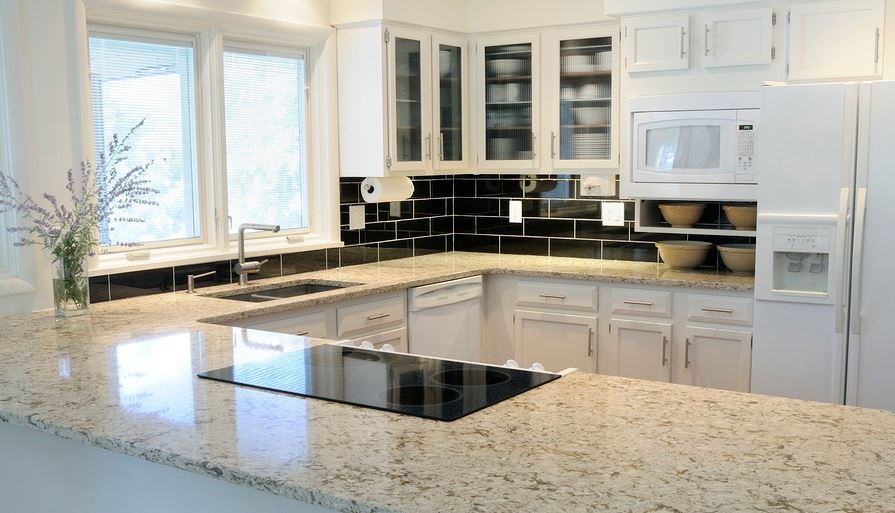
Quartz countertop offerings come in an extensive array of colors, allowing you to choose from different styles and appearances. Coarser-ground quartz typically leads to a flecked, textured appearance, while finely ground quartz produces a more uniform, countertop design. Our home design team can help you select the perfect color colors, patterns and grain size to complement your other aesthetic choices.
ENVIRONMENTAL IMPACT OF QUARTZ:
Quartz is an extremely abundant material, making quartz countertops a relatively low environmental impact material. Additionally, the abundance of this mineral typically makes it easy to source the materials locally, cutting down on emissions during transportation. Many of our quartz providers have been certified by GREENGUARD as low-emitting companies, and other brands mine and manufacture their quartz countertop products entirely in the USA.
CLEANING of QUARTZ KITCHEN COUNTERTOPS and QUARTZ BATHROOM COUNTERTOPS
- Wipe with a mild dish soap and a soft rag
- Remove tough stains from your quartz countertops with denatured alcohol- DO NOT use acetone
Prevent quartz countertop damage by following these simple steps:
- Stay away from harsh cleaners and abrasive sponges and cleaners, including bleach
- Clean up spills immediately
- Protect your quartz countertops from high temperatures
Refer to your specific manufacturers care and cleaning instructions complete details – see links below for our companies
Our selection Premium Brands Quartz Countertop Brands
Silestone Quartz
Caesarstone Quartz
Q-Quartz by MSI
Aggranite Quartz
Vicostone Quartz
Viatera by LX Hausys
Hanstone Quartz
Difiniti Quartz
Trends in Quartz
Valiant Quartz
Corian Quartz
Tab Quartz
GS Granite World Quartz
Diresco Quartz
Wilsonart Quartz
Contact Us
WHY GALLERY 77

Our experienced staff will work with you and your interior designer, builder or contractor, to create original designs that reflect your personal style.
Elevate Your Home with the Timeless Elegance of Natural Stone
TILE
Tile is a manufactured piece of hard-wearing material such as ceramic, stone, metal, or even glass, generally used for covering roofs, floors, walls, showers, or other objects such as tabletops. Tiling stone is typically marble, onyx, granite, or slate.
NATURAL STONE
Natural Stone refers to products quarried from the earth, used over thousands of years as building materials and decorative enhancements. These products include Granite, Marble, Limestone, Travertine, Slate, Quartzite, Sandstone, Adoquin, Onyx, and others.
ENGINEERED QUARTZ
Unlike natural stone countertops cut from pure granite, marble, or sandstone, engineered stone counters are made from quartz crystals held together with a resin binder. They have a similar appearance to natural stone, but they possess benefits not available with natural materials. Quartz bathroom countertops have been very popular in the past few years.
The Making of Engineered Quartz Countertops
Comparing Natural Stone and Engineered Quartz
Why Quartz Bathroom Countertops are Gaining Popularity
Engineered Quartz Countertops: Comprehensive Expert FAQ & Resource Guide
What exactly is "Engineered Quartz," and how is it manufactured?
Engineered quartz is a composite material made from roughly 90–95% crushed natural quartz aggregates (one of the hardest minerals on Earth) and 5–10% polyester resin binders and pigments. This mixture is subjected to a process called vibro-compression under a vacuum, which removes all air and creates an incredibly dense, nonporous slab. Unlike natural stone, which is quarried in blocks, quartz is “manufactured” to ensure structural consistency and pattern predictability.
Is quartz "heat resistant" or "heat proof"?
This is a critical distinction for 2026 home safety. Quartz is heat resistant, but not heat proof. Because the stone is held together by polymer resins, extreme temperatures (above 300°F) can cause the resin to burn or “shock,” leading to permanent discoloration or cracking. While it can handle brief contact better than laminate, we strictly advise using trivets or hot pads for all pots and pans coming off the stove to protect your investment in luxury countertops.
Why does quartz never require sealing like Granite or Marble?
During the manufacturing process, the vacuum-pressing stage eliminates all microscopic pores within the material. This makes the finished slab completely nonporous. Bacteria, mold, and liquids cannot penetrate the surface, meaning it is inherently stain-resistant and hygienic without the need for the chemical sealants required for Natural Stone.
Can engineered quartz be used for outdoor kitchens in Wisconsin?
Standard engineered quartz is generally not recommended for outdoor use in the Midwest. Most resins are not UV-stable, meaning prolonged exposure to direct sunlight will cause the colors to yellow or fade over time. Additionally, the extreme freeze-thaw cycles can cause the resin-bound material to contract and expand at different rates than the stone, potentially leading to cracks. For outdoor projects, we recommend Sintered Stone or specific outdoor-rated quartz lines like Caesarstone’s Outdoor collection.
How do I remove a "permanent" stain from a quartz surface?
Most “stains” on quartz are actually surface marks (like metal rub from a pot or dried ink). Because the stone is nonporous, the substance is sitting on top. For stubborn marks, we recommend using a small amount of denatured alcohol on a soft cloth. Never use acetone, as it can chemically react with the resins and leave a permanent “haze” on the finish. For daily care, a simple mixture of mild dish soap and warm water is the most effective cleaning method.
What is the difference between "Fine Grain" and "Coarse Grain" quartz?
This refers to how finely the natural quartz crystals were crushed before being bonded. Fine-grain quartz looks very smooth and uniform, often used to replicate the look of concrete or limestone. Coarse-grain quartz contains larger chunks of stone, creating a flecked, “sparkly,” or multi-dimensional appearance similar to traditional granite.
Does quartz have "dye-lots" like tile?
Yes. While quartz is more consistent than natural stone, it is still made in batches. There can be slight color shifts between different production runs. At Gallery 77, we ensure that if your project requires multiple slabs, they are pulled from the same “lot” to ensure a perfect color match across your kitchen island and perimeter.
Is quartz more environmentally friendly than natural stone?
Quartz is one of the most abundant minerals on earth, and many manufacturers use recycled glass or stone scraps in their mix. Furthermore, many of our brands, like Silestone and Caesarstone, are GREENGUARD Certified, meaning they meet strict chemical emissions standards. Sourcing brands that manufacture in the USA also reduces the carbon footprint associated with international shipping.
Can quartz be "Bookmatched" for backsplashes?
Traditionally, quartz patterns were too uniform for bookmatching. However, modern 2026 printing technologies allow manufacturers to create “mirrored” slabs specifically for full-height backsplashes. This creates a dramatic, high-end look where the veins flow seamlessly from the counter up the wall.
How does the price of quartz compare to Granite?
Quartz is generally comparable to “Level 2 or 3” Granite. While you can find very cheap entry-level granite, high-quality engineered quartz offers better long-term value for many homeowners because it eliminates the ongoing cost of sealers and professional deep cleanings. We offer flexible financing to help bridge the gap for premium quartz selections.
Why are "Quartzite" and "Quartz" often confused?
The names are similar, but the products are entirely different. Quartzite is a 100% natural metamorphic stone that must be sealed. Quartz (Engineered Stone) is a man-made composite. If you’re struggling to decide, check out our Granite vs. Quartz ultimate guide to see which fits your lifestyle better.
What is a "Jumbo Slab," and why is it important for modern kitchens?
Standard quartz slabs are roughly 130″ x 65″. “Jumbo” slabs can reach 139″ x 79″ or larger. Choosing a Jumbo slab is an actionable way to avoid seams on extra-large kitchen islands, which are a major trend in contemporary interior design.
Are there different "finishes" available for quartz?
Yes. While “Polished” (high gloss) is the most common, many manufacturers now offer “Suede” or “Matte” finishes. These have a soft, non-reflective feel similar to honed natural stone. Be aware that matte finishes may show fingerprints and oil marks more readily than polished ones and may require slightly more frequent wiping.
Can I use bleach to disinfect my quartz countertops?
We strongly advise against using bleach or high-pH cleaners. Bleach can cause the bond between the resin and the quartz to weaken, eventually leading to a dulling of the surface. Because quartz is nonporous, it doesn’t “harbor” bacteria anyway—warm soap and water are all that’s needed for a hygienic surface.
Does quartz fade in rooms with lots of windows?
While not as sensitive as it would be outdoors, quartz can be affected by long-term exposure to intense, direct UV light through windows. If your kitchen has massive south-facing windows, we may suggest certain UV-resistant brands or Natural Stone, which is unaffected by sunlight.
How visible are the seams in a quartz countertop?
Because quartz has a consistent background color, our fabrication team can often make seams almost invisible by using color-matched glues. However, if you choose a quartz with a large “Calacatta-style” vein, the vein will likely break at the seam unless the slabs are bookmatched or carefully layout-planned.
What is "Micro-shimming" during installation?
Since quartz is a rigid product, your cabinets must be perfectly level. During installation, our crew uses “micro-shims” to ensure the quartz is perfectly supported across its entire span. This prevents the “flexing” that can cause seams to pop or the stone to crack under pressure.
Can I use quartz for my fireplace surround?
Yes, but only if it is a decorative surround and not in direct contact with the firebox. For gas or electric fireplaces where the surface doesn’t exceed 300°F, quartz is a beautiful, low-maintenance option. For wood-burning fireplaces, we recommend Natural Stone or Tile.
Is quartz "scratch-proof"?
Quartz is highly scratch-resistant (it ranks a 7 on the Mohs hardness scale), meaning a stray fork or plate won’t scratch it. However, it is not scratch-proof. Diamonds, sapphires, and other quartz pieces can scratch it. Always use a cutting board to maintain the factory finish.
Why do some quartz brands cost more than "big box store" quartz?
Premium brands like Silestone and Caesarstone invest heavily in R&D to create more realistic veining that goes all the way through the slab (not just printed on top). They also offer better warranties and have stricter quality control regarding resin-pooling (blobs of resin in the pattern) and slab flatness.
What happens if my quartz countertop chips?
Like natural stone, quartz can be repaired with color-matched acrylic resins. This is a common service for “sink-swing” chips where a heavy pot hits the edge of the sink cutout. Our Hudson-based team can typically perform these repairs onsite.
Is quartz safe for food preparation?
Yes. Most major quartz brands are NSF (National Sanitation Foundation) certified, meaning they are tested and approved as a safe surface for direct food contact. Its nonporous nature makes it one of the safest materials for bathroom and kitchen health.
Can I install quartz over my existing laminate countertops?
No. Stone and quartz must be installed directly onto the cabinet base to ensure proper support and leveling. We offer professional removal services to help prepare your home for your new surfaces.
How thick are quartz countertops?
The most popular and durable thickness is 3cm (approx. 1 ¼ inches). Some modern designs use 2cm (approx. ¾ inch) with a mitered “built-up” edge to make the counter appear much thicker (up to 4 or 6 inches) for a “waterfall” island effect.
Why choose Gallery 77 for quartz countertops?
We don’t just sell you a slab; we provide a complete design and education experience. Our 23 years of experience ensures that from the laser template to the final polish, your quartz surfaces are handled with absolute precision.