
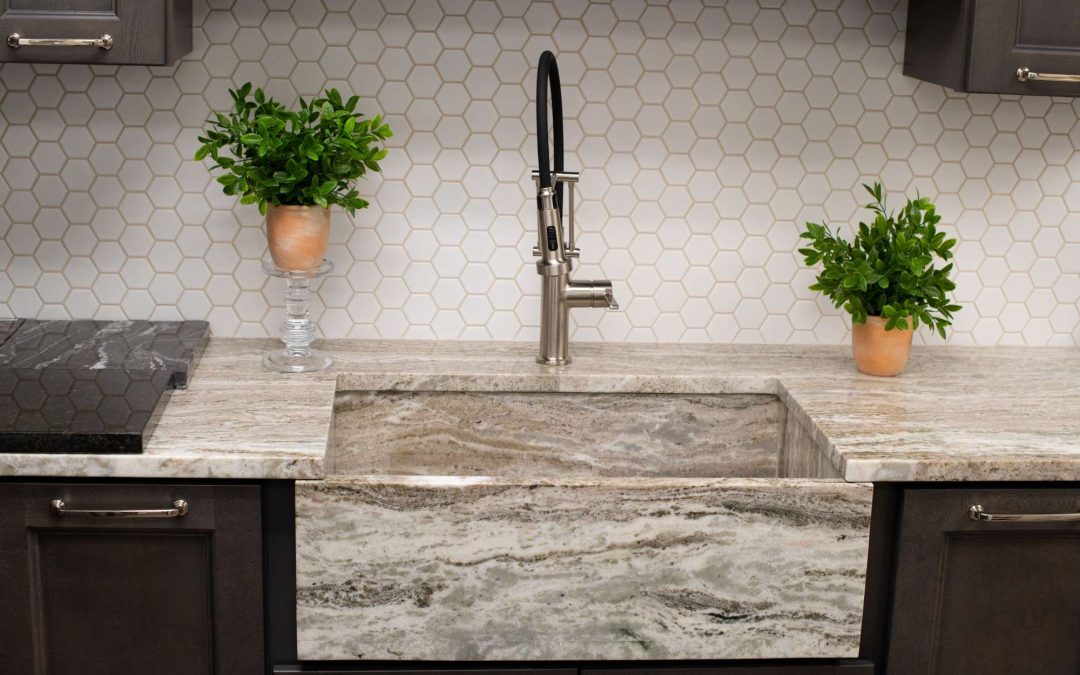
The Gallery 77 team is on a mission – and a very honorable one at that. We’re here to provide homeowners across the greater Hudson, WI area with the best selection of countertops they will ever know. That is why we’re going beyond tile, natural stone and engineered quartz by introducing two new durable and aesthetically pleasing surfaces: sintered stone and porcelain!
What Is a Sintered Stone Countertop?
Sintering is the process of turning a powdered material into a solid mass by heating and compressing it. Sintered stone brands like Dekton by Cosentino and Lapitec are renowned for their durability and aesthetic appeal, offering a wide range of colors and patterns to suit any design preference.
Some sintered products are brittle and actually designed to disintegrate, such as frangible projectiles by SinterFire. But when the correct minerals and manufacturing process are used, sintering produces an outstandingly dense stone-like surface that can’t be etched. But a sintered stone countertop is more than just harder than traditional engineered quartz!
- Sensually pleasing. Sintered stone doesn’t require sandblasting in order to feature a nice texture. It comes straight out of the factory with a surface that is pleasing to the touch. Sintered stone is also gorgeous, with virtually any color or pattern you could conceive.
- Immune to heat. Sintered stone is formed under extremely high temperatures, and is therefore virtually unaffected by intense heat. Remove a pot from your roaring hot oven and place it directly on your sintered stone countertop. It will be no worse for wear!
- Resistant to fading. Unlike quartz or natural stone, sintered stone boasts exceptional resistance to ultraviolet (UV) light. That makes it the perfect choice if you want a fadeproof countertop for your outdoor kitchen. Sintered stone is also just as resilient to cold as it is heat, so it stands up to the Midwest’s harshest weather.
- Easy to install. Although sintered stone is a manmade material, its color and pattern aren’t surface deep. They run throughout the entire thickness of the slab, which makes edge detail and seaming a whole lot easier.
- Eco-friendly. Sintered stone is held together by heat and pressure alone. It does not contain resin, plastic, or petroleum byproducts. Better yet, its low silica content makes sintered stone’s installation significantly less hazardous to pulmonary health.
What Is a Porcelain Slab Countertop?
Porcelain is a type of ceramic, albeit one which is much harder than traditional pottery because it is fired at such high temperatures (2,200-2,600 °F).
Porcelain is hardly a revolutionary new material; it was invented in China over 1,000 years ago, and porcelain tile countertops are already quite popular. But when a single, continuous porcelain slab is installed as a countertop, it’s due to provide several great benefits.
- Durable. Porcelain is almost 30% stronger than even the hardest granite. It is so resistant to scratching that you can cut food right on its surface without scratching it. (Doing so is not recommended if you care about your knives.)
- Heat resistant. Like sintered stone, porcelain is formed under blazing hot temperatures. Nothing that comes out of your oven will be capable of burning your porcelain slab countertop – perfect if you’re tired of using trivets.
- Nonabsorbent. Porcelain is so dense that its absorption rate is less than 0.5%. It doesn’t stain easily, nor does it retain moisture that could nourish mold. You’ll be able to ignore spills until you’re all done cooking.
- Resistant to fading. Unlike engineered quartz, porcelain is extremely resistant to UV light. Its color won’t fade if it is placed outside or in a kitchen with lots of natural light!
- Surprisingly lightweight. The word “slab” may bring an enormous, heavy object to mind, but this is not the case when you’re talking about porcelain. It is surprisingly strong even when it is relatively thin (the reason why porcelain is also used to make dental veneers), which simplifies installation and ensures that your underlying cabinetry doesn’t get crushed.
- Colorful. Porcelain isn’t bone white as a rule. As an engineered material, it can be fabricated with any color or pattern you imagine. Whether you want a solid color, an artistic pattern, or a pattern which perfectly mimics natural stone, porcelain makes it all possible.
- Eco-friendly. Porcelain is made of clay-based materials: a 100% natural product that you have the option to recycle.
Are you remodeling a kitchen or bathroom in the greater Hudson, WI area? Then we welcome you to contact Gallery 77 today to learn more about our exciting new sintered stone and porcelain slab countertop options No matter your culinary goals or aesthetic vision, we have the ideal countertops for your home or business!
Recent Comments